6-7 has had a grip on the internet for almost a year. Most memes last year only lasted a week, yet 6-7 continues to be relevant.
Even teachers have taken note.
NASH math teacher Mrs. Perry noted, “I try to joke about it a little bit to lighten the mood.”
At Peebles Elementary, counselor Jenna Stand also joined the trend, as the Pittsburgh Post-Gazette recently reported.
“As a staff, we said, ‘If we can’t beat them, let’s join them,’” Stand told the P-G regarding Peeble’s decision to hold a celebration on the 67th day of school.
Although older generations may be confused by the popularity of what seems like a meaningless number, the reason 6-7 continues to spread is that it breaks the typical meme life cycle.
Memes become popular due to their instant relatability. However, as they spread (and often very rapidly in the era of short-form content), their uniqueness wears thin and they soon join the graveyard of dead memes. Notably, 6-7 has defied this pattern.
Before TikTok entered the scene, Vine dominated short-form video content. Many classic memes originated on Vine and stayed relevant even after the platform was discontinued. For example, the “What’s 9+10?” meme led to 21 becoming a meme number. Although 21 appeared in many meme compilation videos, it wasn’t overused too quickly. Therefore, it stayed relevant for a long time, though most of its original impact faded.
Dank memes were also a major trend before 2020, having blown up around 2014 as a response to mainstream media.
CCCBLab stated, “The dank culture always sought the limit (self-awareness, self-reference and self-destruction), fleeing comprehension by the majority, avoiding digestion by the mainstream. Probably, this rejection of the majority was caused by the fact that while the dank meme concept gradually developed.”
Dank memes tried to be edgy as a way to exclude certain members.
Aryaman Dubey, a senior at NASH, explained, “Dank memes died because society moved on from what was described as dankness. People in the community started to exclude other people to maintain the inclusivity of the meme. Dank memes turned into hate speech disguised as memes as a way gate keep their community.”
Ms. Polcyn, NASH’s AP Psychology teacher, offered her insight as to why people try to exclude others from joining their groups.
“Groups want to elevate themselves and feel ‘unique,’” she said. “They see everyone trying to come into their community as homogeneous. Wanting to preserve their uniqueness, they start to exclude other people, no matter what.”
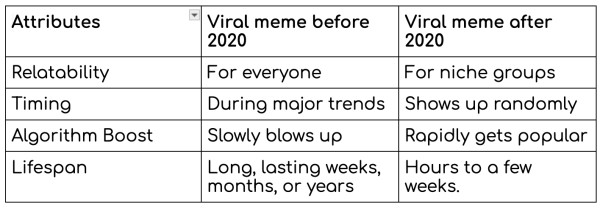
With the rise of TikTok and short-form algorithms, memes can surge to popularity very quickly. Ironically, the sudden explosion often kills the meme quickly. When a meme is pushed out to too many people in such a short time frame, its novelty soon wear thin.
According to Michael R. Ward, a business professor at the University of Texas at Arlington, “Estimates indicate that a temporary elevation in attention dissipates within just one to two weeks. However, meme saturation then leads to less spread of the meme. To be effective, meme marketers must remain attentive to where the meme they intend to use is within the fad cycle…. Eventually, diminishing marginal utility causes the entertainment value to revert to preshock levels…. Many adopt the fad that it no longer elevates status and, instead, signals low status. Agents stop participating in the activity and move on to the next activity.”
The problem lies in the rise of algorithms, leading to meaningless memes.
Adam Clark Estes, a senior technology correspondent at Vox, stated, “These products are designed to keep you engaged, to steal as much of your attention as possible…. The algorithm proved extremely effective at getting people to spend more time on the app…. Making content easier to produce will lead to more content, which leads to more engagement, which leads to more ads.”
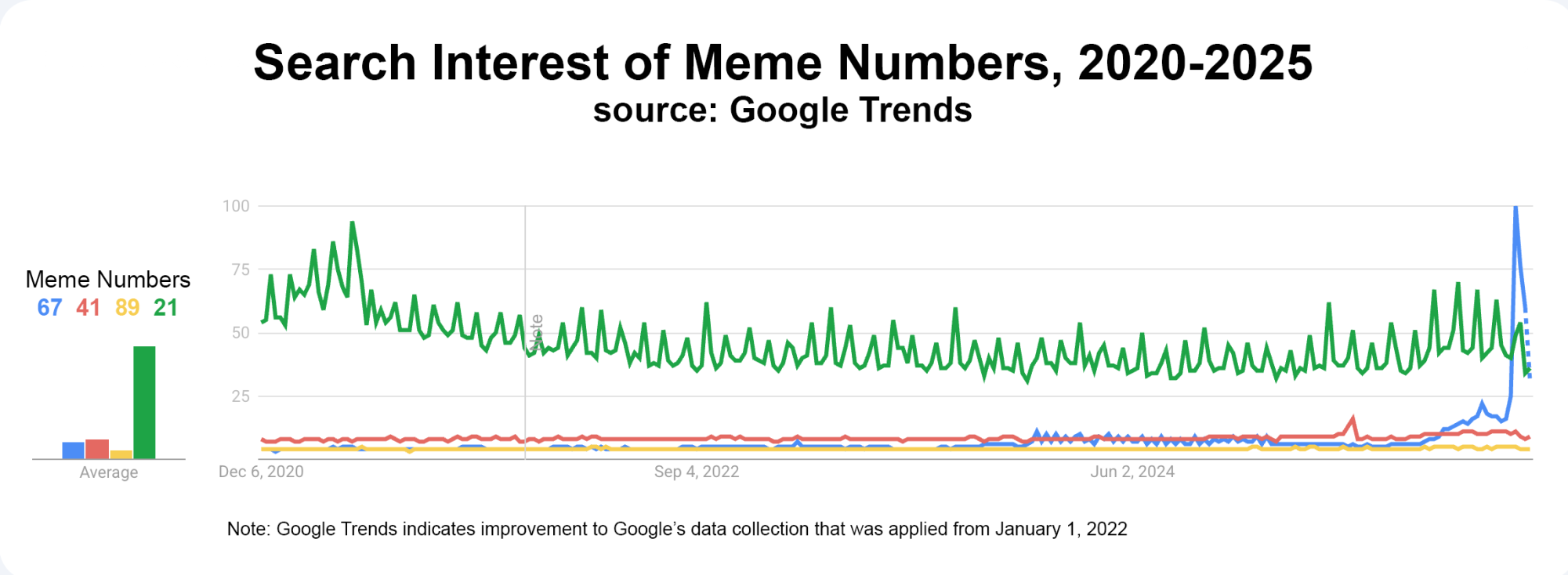
Ironically, 6-7 manages to stay relevant because it’s annoying. It became so overused that people got sick of it, which would normally spell the end for the meme’s life cycle. For instance, when younger kids started saying 41 or 89 instead of 6-7, 6-7 rose in popularity again. Now, it is now mainly used to make fun of how the internet makes memes and annoy people.
Seeing the rise of 6-7 from the grave, the internet has since collectively decided that 6-7 can never die. The meaning of 6-7 changed from an absurd number to a trend that irritates people, which some find funny. Other “funny numbers” popped up in the fall of 2025, but they all died quickly. These funny numbers felt forced by the algorithm, ruining their longevity. No meme numbers lasted longer than two weeks. 6-7 is the first meme of 2025 that has made it into 2026, but it will shortly die out.