
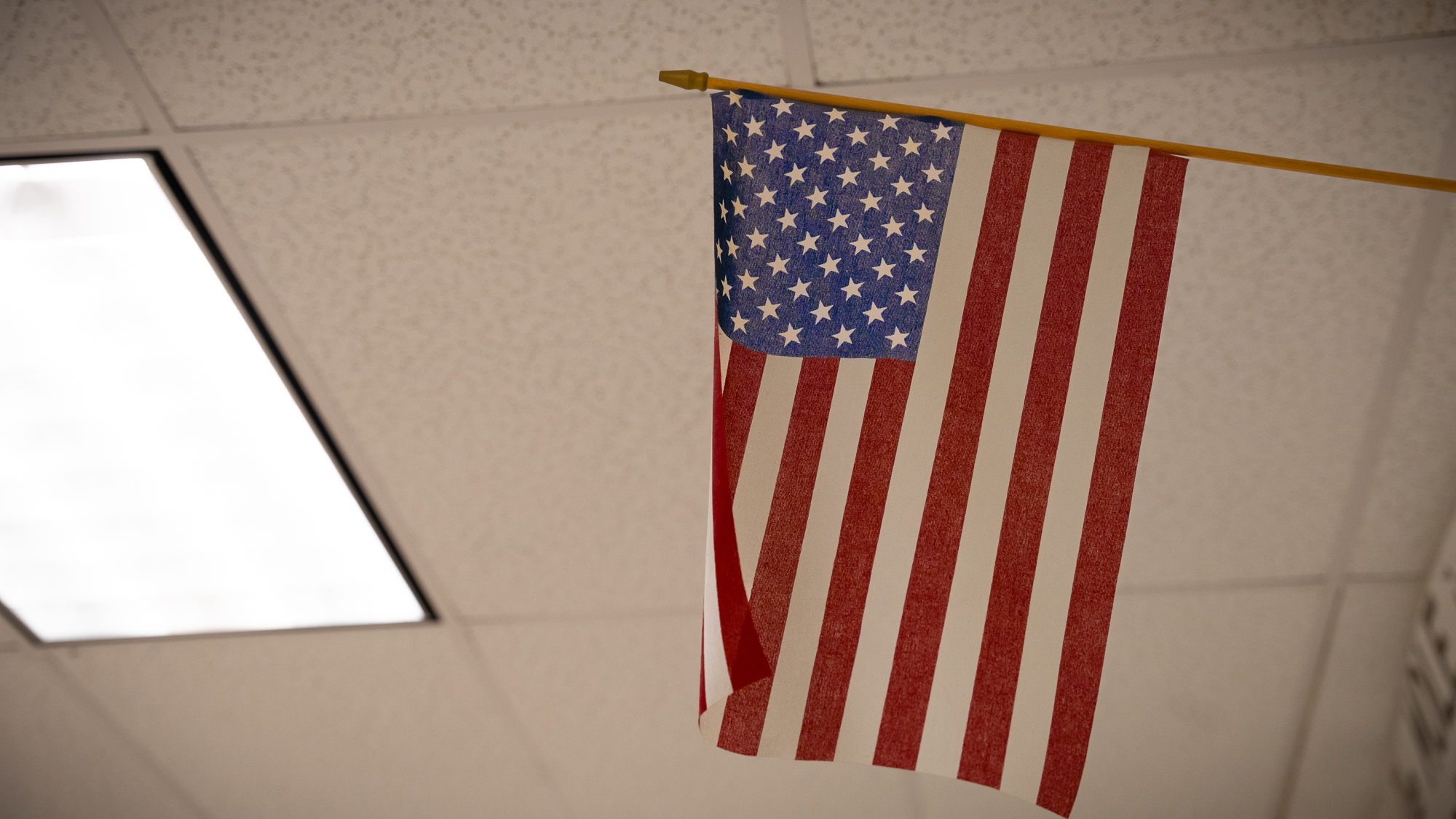
Every day, students across the country rise from their desks, face the flag, and recite words embedded in their minds from years of repetition. For some, the Pledge of Allegiance holds significant meaning and symbolizes being part of something greater than themselves. But for others, its recitation is no more than a routine, while many opt not to participate at all.
The first version of the Pledge of Allegiance was written in 1885 by Captain George Thatcher Balch, a Union army officer in the Civil War who advocated for teaching patriotism to children in public schools. In 1892, a revised version was written by Francis Bellamy, who later went on to campaign for the addition of Columbus Day as a national holiday.
Originally published in The Youth’s Companion, a children’s magazine, it gained widespread popularity in classrooms and gradually became a symbol of American civic identity, being formally adopted by Congress in 1942.
While schools often encourage students to recite the Pledge, the Supreme Court has ruled that participation cannot be required. In cases such as West Virginia State Board of Education v. Barnette, the Court cited the First Amendment’s protection of freedom of speech and religion to affirm that it was unconstitutional to compel students to salute the flag. Explaining this decision, Justice Robert H. Jackson stated, “A person gets from a symbol the meaning he puts into it, and what is one man’s comfort and inspiration is another’s jest and scorn.”
Despite this ruling, the practice of the remains controversial in many schools as debate ensues over whether students should stand out of habit, respect, or personal conviction. So how do students and teachers at NASH perceive the continuation of this tradition today?
Many educators view the Pledge as more than just a daily routine. AP U.S. History teacher Mr. Venezia sees it as an important part of teaching civic values in schools.
“I always tell my students that part of our job is to teach citizenship skills – particularly in the social studies department,” he stated, “I always stand and say it and encourage by modeling. I tell my kids that if they choose not to stand for the Pledge, I hope it is for a thoughtful reason, and laziness isn’t a valid one.”
Similarly, AP Economics and U.S. History teacher Mr. Tengowski expressed comparable sentiments, emphasizing respect for those who have served their country while still recognizing students’ freedom when it comes to choosing whether to participate.
“I will always show the Pledge and, personally, stand and say it out loud. However, I will not make anybody stand because it is their decision. It’s a free country. I’m of the opinion that saying the Pledge is a way to respect those who have sacrificed for this country,” Mr. Tengowski explained.
In both classrooms, these teachers aim to lead by example. Instead of requiring participation, they hope to let their students make the decision for themselves.
Conversely, NASH students seemingly take an opposite stance: many treat the Pledge with ambivalence or apathy.
NASH senior Cate Lukitsch elaborated, “Personally, I don’t stand for the Pledge because I don’t feel very connected to the United States and its national identity.”
Other students claim that the Pledge has simply become easy to ignore during the school day. One anonymous student described a lack of engagement among classmates: “There seems to be a general feeling of indifference toward the Pledge in high school. During homeroom, if there isn’t a teacher paying attention, most people just don’t bother doing it.”
Contrastingly, NASH junior Aidan Shaffer said, “I stand because it’s a tradition. I feel like it’s a sign of reverence for the country and its struggles and triumphs — it’s a very powerful anthem that has resonated through time.”
Another anonymous NASH senior suggested that part of the detachment comes from how little students reflect on the words themselves.
“I’ll stand for the Pledge, but I feel pretty disconnected from it. I think that’s normal among students because it’s like some mindless speech we give at 8am when we’re half asleep,” the student explained.
As these responses suggest, the Pledge appears to function as less of a patriotic expression and more as a routine recitation that lacks personal meaning.
While the official Pledge of Allegiance is a distinctly American practice, many countries have their own ways of encouraging national pride and civic responsibility in schools. In India, for example, many schools begin the day with a morning assembly in which students recite the National Pledge of India, an oath emphasizing unity and dedication to the country.
In Japan, schools often hold ceremonies involving the flag and the singing of the national anthem during assemblies and formal events. Although Japan does not have a daily spoken pledge like the United States, these customs similarly reinforce ideas of national identity among students.
Therefore, although the American Pledge is unique in its wording, many nations incorporate alike traditions within schools that encourage reflection on citizenship.
Ultimately, perspectives on the Pledge of Allegiance at NASH vary widely. While there is a tendency for some teachers to see it as a meaningful reminder of civic values and the nation’s history, many students view it as little more than a routine part of the school day.
However, traditions aimed to encourage national pride and unity are not unique to the United States, as illustrated by India’s and Japan’s school systems. Whether they are embraced with enthusiasm and respect or treated with indifference, these practices continue to prompt controversy over the role of patriotism and personal autonomy in schools all over the world.

sheep • Mar 12, 2026 at 8:33 am
God Bless America!