

Founder. President. Vice President. Head of Communications. Creative Director.
Familiar titles like these are being seen at increasing rates at high schools all over the country, not just at NA. Leadership roles are a common extracurricular explored by many students, acting as an opportunity to explore interests and build more personal communities outside of the classroom. However, with the increase in the competitive nature of college admissions in recent years, these positions have taken on a new meaning as a way to stand out on applications.
At NASH, the number of student-led clubs has seen a steady increase in the last decade. While many of these organizations begin with genuine enthusiasm or passion for a cause, others seem to present an ulterior motive, posing the controversial question of being created primarily to add leadership titles to a resume.
“I’ve seen it, hands down. My friends have admitted to me that they’ve created clubs more for the purpose of saying that they did than for any other reason, certainly including out of their own interest,” said one NASH senior who asked to remain anonymous.
As extracurricular involvement becomes a more impactful factor on college admissions, the motivations behind starting and leading clubs has begun to come under scrutiny by fellow students and teachers alike.
For many students, the decision to create a club does not come from a single motivation, but from a mix of genuine interest and practical considerations for the future. They hope that having strong extracurricular involvement will help them There’s a visible difference between attendance at the beginning of the year versus right around when the new year hits.[/pullquote]stand out among the crowd.
Advice about the admissions process from counselors and online resources often reinforces this idea, emphasizing the importance of being more than just a general member of a club in order to show initiative and impact. As a result, creating a club can appear to be a simple way to demonstrate responsibility.
However, the oversaturation of leadership roles has diluted their effect, along with prestige.
“It seems like there’s a club at NASH for any topic you can imagine – not saying it’s a good or bad thing, but a lot of it just seems forced rather than authentic. It feels like a show,” said another NASH senior.
While the expansion and diversification of clubs allow students to consider previously unexplored interests, it can also lead to challenges. With so many clubs competing for members’ time and attention, some struggle to maintain consistent attention or long-term participation.
Some students have begun to notice the pattern themselves: “There’s a visible difference between attendance at the beginning of the year versus right around when the new year hits. Certainly once spring comes around and people get accepted into colleges, they just stop showing up and caring. It really shows some people’s true colors,” explained an anonymous club president at NASH.
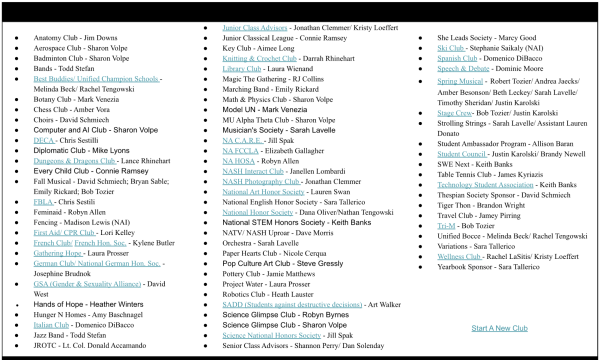
Many students asked to remain anonymous in their critiques of performative clubs and their leadership roles, demonstrating a reluctance to do anything that may sacrifice their spot at a top college by weakening their own credibility.
However, if anyone has noticed this growing lack of authenticity when it comes to extracurriculars, it’s teachers.
“I understand that many students take on leadership roles to strengthen their college applications, but that motivation can sometimes overshadow the true purpose of clubs—to engage in activities they genuinely enjoy with like-minded peers. It raises the question: if leadership titles were removed, would as many clubs still exist, or are they being sustained more by resume-building than by real interest?” stated librarian Ms. Vora.
So many of these organizations are created and exist for a handful of years before becoming inactive after their founders graduate, no longer with a reason to continue these clubs. While many new clubs exist simultaneously, sustaining momentum and creating substantial impact can become difficult.
Nevertheless, there are undoubtedly positive aspects to this growth in student organizations, from acting as a community in which students can connect over shared interests to providing volunteer opportunities and a way to give back to the community. Even clubs with a small and intimate following can grow into meaningful circles given members remain committed.
Ultimately, the question of why students start clubs does not always have a clear answer. It is true that ambition and genuine passion can both be equal reasons, and many students are forced to weigh both when choosing how to spend their time in high school in conjunction with class rigor and course load.
“It’s pretty clear what’s going on. Even the officers show a lack of commitment. As a member of an honor society I will not name, I feel like I am being done a disservice. There is a complete lack of organization and communication by those in charge,” explained one NASH senior.
What so often determines a club’s success or impact is not the original motivation but the level of commitment that follows. Clubs built around real, unfeigned interest tend to attract consistent participation and continue even after their founders move on. If clubs are just another line on a person’s list of achievements, the true purpose of student organizations risks getting lost along the way.
________________________
Editors’ note: All opinions expressed on The Uproar are a reflection solely of the beliefs of the bylined author and not the journalism program at NASH. We continue to welcome school-appropriate comments and guest articles.

Sheep • May 5, 2026 at 9:59 am
So many clubs!